Closing the payload QC gap in RNA-LNP development

The challenge
Lipid nanoparticles (LNPs) is the leading non-viral delivery platform for RNA therapeutics, enabling the successful clinical application of siRNA therapeutics and mRNA-based vaccines.
Inside TX’s TAMARA microfluidic platform provides highly controlled, reproducible RNA-LNP production across formulation volumes, from early-stage screening to preclinical studies. Using it, researchers can screen formulation parameters (e.g., lipid compositions and N/P ratio) and process parameters (e.g., TFR and FRR) at low volumes — down to 200 µL — with minimal RNA input and near-zero material loss.
But formulating a candidate is only half the workflow. Every formulated batch still has to answer one question before it can move forward: how much RNA actually made it into the particle?
Alongside robust formulation, encapsulation efficiency is one of the key quality attributes tracked in RNA-LNP development, and the RiboGreen assay is the usual way to get it — simple, high-throughput, widely adopted. However, RiboGreen Assay relies on detergent-mediated nanoparticle lysis and multiple sample preparation, and requires roughly two hours per batch. For a formulation team running multiple candidates a day on a fast, low-volume system, the analytical step becomes a bottleneck.
Inside Therapeutics, the makers of TAMARA microfluidic formulation platform, teamed up with Marama Labs to demonstrate a workflow for RNA-LNP development that is faster, simpler and most importantly - has less variance.
Approach
PolyA quantification was performed using two analytical methods: the conventional RiboGreen (RG) assay and the CloudSpec RiboGreen (CS-RG) assay. Both methods were used to quantify free polyA, total polyA, and encapsulation efficiency (EE%) of SM-102 LNPs prepared under three different formulation conditions.
While RiboGreen assay is simple, sensitive, and well suited for high-throughput screening, accurate total RNA quantification depends on complete nanoparticle disruption and involves multiple sample preparation steps, making the workflow susceptible to potential variability.
CloudSpec uses scatter-free absorbance spectroscopy (SFA) to directly quantify RNA payload in intact LNPs. Unlike conventional UV/Vis measurements, which are affected by light scattering from nanoparticles, SFA captures both transmitted and scattered light to determine the true absorbance of the sample, enabling accurate RNA concentration measurements independent of scattering. Combined with fluorescence-based free RNA detection, CloudSpec enables lysis-independent determination of EE% within a single analytical platform, reducing sample preparation while minimizing potential sources of variability.
The workflow is simple:
- Formulate the RNA-LNP (e.g., an SM-102 or ALC-0315–type composition) on a microfluidic platform such as TAMARA.
- Dilute the intact LNP suspension — no lysis, no separation step.
- Measure on CloudSpec: ~15 seconds per sample, using standard quartz cuvettes.
CloudSpec's dual-pathway optics measure transmission (extinction) and scatter-free absorption simultaneously, then derive the scatter contribution as the difference between the two. Because the RNA's characteristic A260 absorbance is recovered independent of the particle's light-scattering signal, total RNA payload can be read directly from an intact, cloudy LNP sample — the same sample that comes straight off the formulation instrument.
Read the full application note here.
The results
In a head-to-head comparison against RiboGreen on a standard SM-102 RNA-LNP formulation:
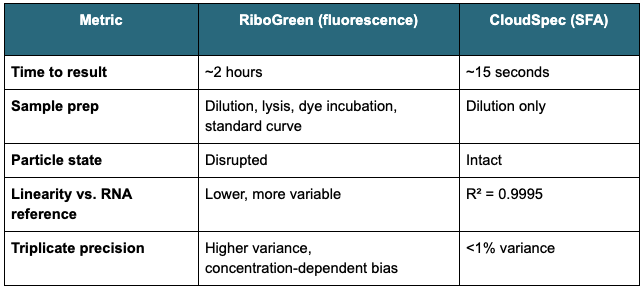
The practical effect is that, following nanoparticle formulation with the TAMARA microfluidic platform, a formulation team can generate size, PDI, and EE% measurements alongside payload concentration from CloudSpec on the same afternoon the batch is formulated, rather than queuing samples for a next-day fluorescence assay.
“Working with the Marama Labs team has been a great experience. Combining TAMARA’s reproducible microfluidic RNA-LNP formulation with CloudSpec's rapid RNA payload quantification demonstrates how complementary technologies can streamline RNA-LNPdevelopment workflows.”
- Sezen GÜL, PhD, Field Application Specialist RNA-LNP & Nanoparticles Formulation Expert, Inside TX
CloudSpec assay showed excellent agreement with the conventional RiboGreen assay for free polyA quantification and encapsulation efficiency while providing total polyA measurements that more closely matched the expected polyA input. By eliminating the need for LNP disruption, the CloudSpec workflow reduces sample preparation, minimizes potential sources of assay variability, and enables rapid, streamlined polyA quantification without compromising analytical performance.
Interested in seeing CloudSpec in action on your own samples? Reach out to us to learn more.