
CloudSpec now measures Encapsulation Efficiency with no lysis

If you formulate mRNA-LNPs for a living, you already know the drill. You've built a promising lipid nanoparticle formulation, and now you need to know one thing before you can move forward: how much of your RNA actually made it inside the particle?
Encapsulation Efficiency (EE) is the most widely measured attribute to characterize mRNA-LNP formulations. It's also one of the most painful to get.
Today, we're changing that. CloudSpec now can measure Encapsulation Efficiency, alongside RNA payload and ligand concentration — all in one instrument. This approach requires only 2 samples, has no LNP lysis step and has a precision of 2%. The CloudSpec-EE method will significantly streamline LNP characterization workflows, removing this longstanding bottleneck in RNA therapeutic development.
The challenges of measuring Encapsulation Efficiency today
The current Ribogreen (RG) assay for encapsulation efficiency requires detergent-mediated LNP lysis, and includes ~8-10 steps. The method is well known to be both labor-intensive and highly variable, with said variability stemming from the lysis process and large number of manual pipetting steps. This is a problem for formulation developers for a number of reasons:
- When the method gives unexpected results, identifying the source of error is difficult (may be lab operator, reagent degradation, sample preparation, etc)
- Measurements often need to be repeated due to unexpected results
- The method is time intensive and can give different results from operator to operator (because of the number of steps involved and different sample preparation techniques between operators)
- There is often low trust in the values from the method
That lysis step is the real culprit. It's the main source of variability in the assay, and it's notoriously hard to troubleshoot when something goes wrong.
The CloudSpec-EE method addresses all of the above concerns because (1) it does not require the lysis step, thereby removing much of the variability in the assay and (2) it requires only 2 samples, significantly reducing the time for the assay and the number of preparation steps, thereby reducing potential operator error.
How CloudSpec solves it
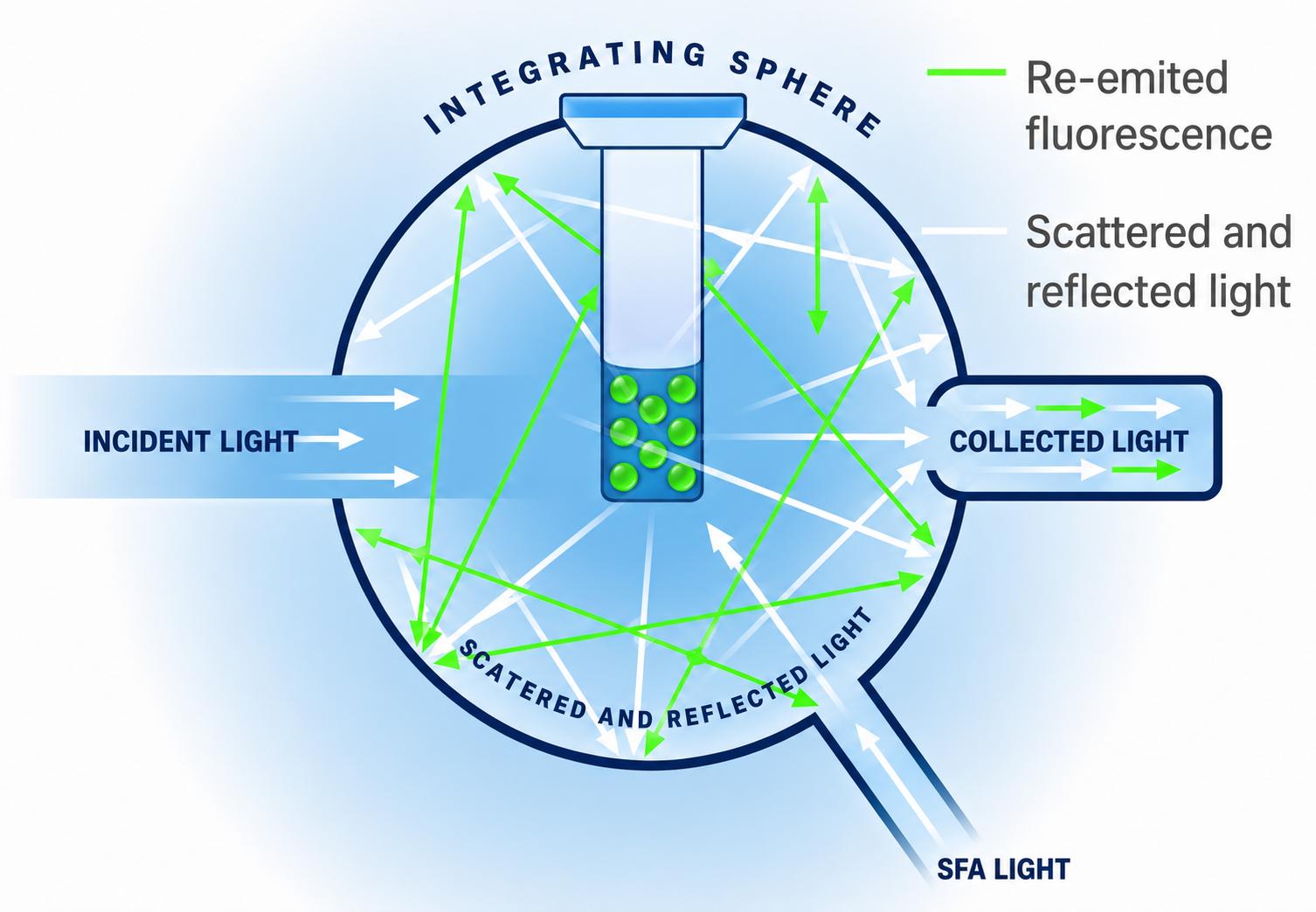
The CloudSpec-EE solution approaches measuring encapsulation efficiency in a new way – by utilising an integrating sphere to collect and measure the fluorescence of Ribogreen dye upon binding to RNA.
Traditional approaches to measuring EE use a dedicated fluorimeter, whereas the CloudSpec-EE method uses a broadband light source and an integrating sphere. The advantage of the CloudSpec method is that the integrating sphere is already configured for highly effective and precise measurement of total RNA concentration (using absorbance at A260) on intact LNPs, because of its ability to eliminate the effects of LNP light scattering on absorbance measurements. The exact same instrument, due to the way integrating spheres work, can be extended to measure fluorescence simultaneously to absorbance. When Ribogreen dye is added to the LNP sample, the fluorescence signal of the dye when it binds to free RNA can be detected in CloudSpec (seen as a negative absorbance at 560nm) and used to quantify the concentration of free RNA. When combined with CloudSpec’s total RNA concentration value, RNA encapsulation efficiency can be calculated directly.
Our technical paper describes the optical principles behind the CloudSpec-EE method, the integrating sphere approach, and the experimental validation in much greater detail.
Why this matters
For formulation scientists, the impact will show up in streamlined LNP characterization workflows and huge time and resource savings:
- Run more EE samples per day. Fewer steps means more throughput without more bench time.
- Spend less time troubleshooting, more time advancing formulations. When the method itself isn't the variable, you can trust the result the first time.
- Lower consumable and reagent costs. Two steps means two samples' worth of reagent, not ten.
- Have more confidence in EE values. Precision you can rely on means decisions you can make with confidence.
How it stacks up to current solutions
Today, most labs cobble together their own EE workflow using an off-the-shelf RiboGreen kit and a standard plate reader; there's no dedicated, purpose-built product for this measurement. Recent solutions on the market, using plate-based systems, also avoids lysis, but it gets there differently: it uses standard UV-Vis spectroscopy and mathematically models and subtracts light scattering from the LNPs to estimate the RNA absorbance spectrum, a workaround that's known to produce unreliable values for many LNP systems. It also requires purchasing a new, dedicated instrument, and because it consumes larger amounts of reagent to generate standard curves, it delivers little, if any, reduction in assay costs.
CloudSpec's integrating sphere physically eliminates LNP light scattering rather than modeling around it, producing more reliable absorbance spectra and more accurate total RNA values — and it does so on the instrument you already have.
Learn more or get in touch
Want to dive deeper? Read our technical paper for the complete methodology, validation data, and the optical principles behind the CloudSpec-EE assay.
Interested in seeing CloudSpec-EE in action on your own samples? Reach out to us to learn more.